- October 9, 2026
- Posted by: admin
- Category: BitCoin, Blockchain, Cryptocurrency, Investments

Polygon’s surging USDT0 holder count masks shrinking balances and suspected scam activity amid its broader push into stablecoin payments.
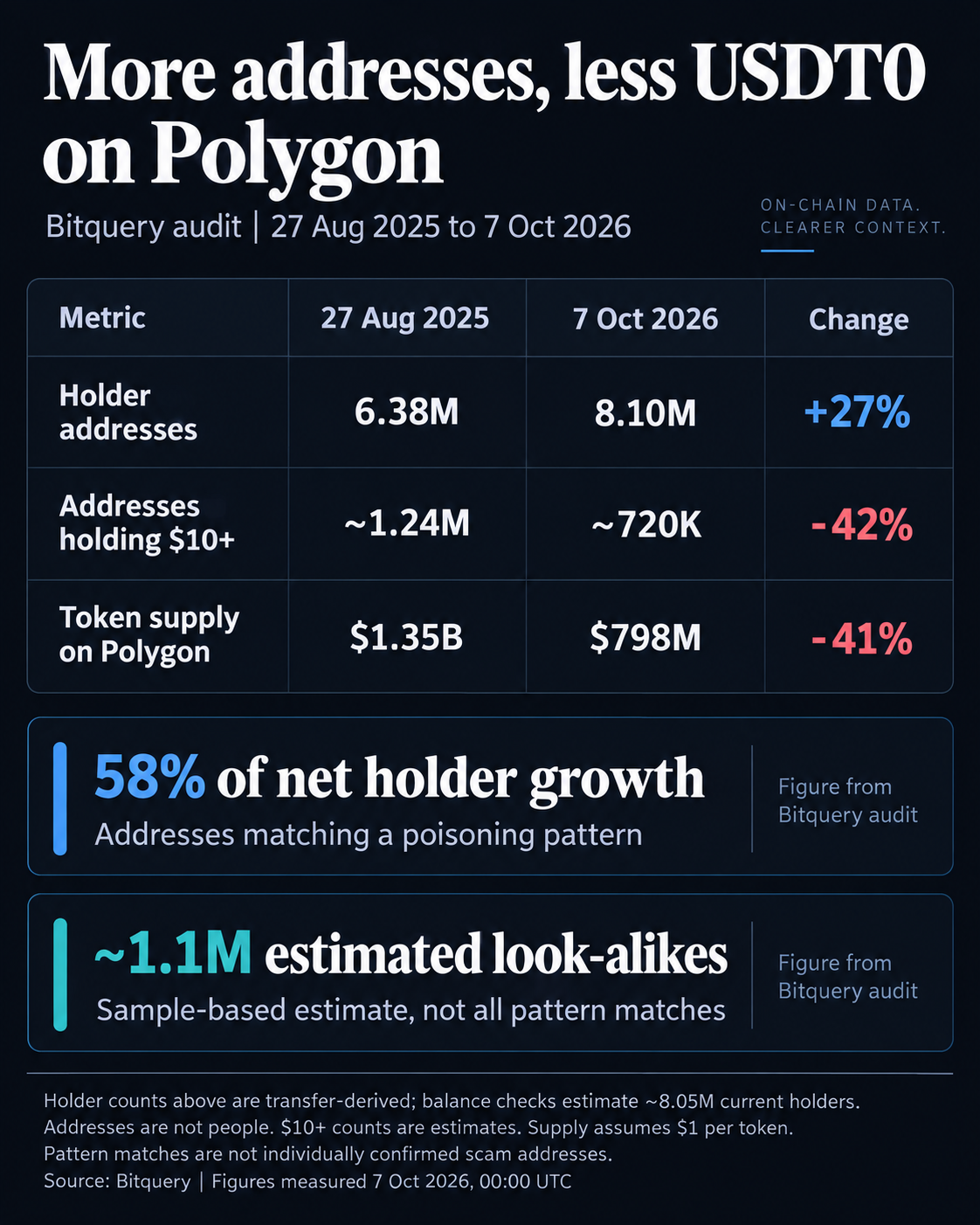
An Oct. 7 investigation by blockchain analytics firm Bitquery found that addresses matching scam patterns accounted for 58% of the net growth in Polygon’s USDT0 holders since August 2025, raising questions about the quality of adoption figures promoted by the network.
The findings challenge Polygon’s recent celebration of surpassing 8.1 million USDT0 holder addresses, the highest among blockchains included in a Token Terminal comparison.
According to Bitquery, roughly 998,000 of the 1.71 million addresses added over the preceding 13 months exhibited patterns associated with address-poisoning scams.
The growth came as USDT0 supply on Polygon fell 41%, from $1.35 billion to $798 million. Addresses holding at least $10 also declined 42%, from approximately 1.24 million to 720,000.
Bitquery found that 48% of holders controlled less than one cent, while 65% had neither sent nor received the token during the preceding year.
The investigation also identified approximately 1.42 million addresses matching an address-poisoning pattern, with sample-based verification supporting an estimate of 1.1 million scam look-alikes.
Address poisoning involves scammers creating wallet addresses that resemble legitimate payment destinations and sending tiny transactions to potential victims, hoping they mistakenly copy the fraudulent addresses when transferring funds.
These addresses can retain fractional token balances, allowing them to count as holders. Bitquery cautioned that its classification was probabilistic and did not quantify losses from the suspected scams.
The findings reflect Polygon’s August 2025 upgrade from bridged USDT to native USDT0, which preserved existing token balances and contract addresses. About 67% of current holders first received Tether before the upgrade.
Polygon’s payments ambitions face a measurement problem
The findings arrive as Polygon increasingly positions itself as a stablecoin payments network, competing for payment processors, institutional liquidity and cross-border settlement activity.
That strategy has coincided with significant transaction growth.
Blockchain analytics platform Growthepie recently reported that Polygon processed more wallet-to-wallet stablecoin transactions over seven days than Ethereum’s mainnet, and more than Base and Arbitrum combined.
The metric excludes decentralized finance contracts, although transfers associated with automated activity, including address poisoning, could still contribute to transaction counts.
Meanwhile, DeFiLlama data shows Polygon holds approximately $2.93 billion in stablecoins, with Circle’s USDC accounting for $1.62 billion, or 55.29% of the market.
Tether remains the network’s second-largest stablecoin, with approximately $795 million in supply, representing about 27% of the total.
The figures suggest that Polygon’s broader stablecoin activity has developed differently from Tether’s shrinking capital base, although Bitquery’s findings do not establish whether genuine USDT0 payment volumes have declined.
The post Polygon’s 8 million USDT0 holders face scrutiny as 58% of growth matches scam patterns appeared first on CryptoSlate.