- April 27, 2026
- Posted by: admin
- Category: BitCoin, Blockchain, Cryptocurrency, Investments
Bitcoin is pushing toward $79,000 as the market finds its footing after weeks of pressure and uncertainty. The recovery has been gradual but consistent, and bulls are beginning to test levels that matter. But according to on-chain analyst Axel Adler, the price is approaching a zone that carries specific structural implications — one that will determine whether the current strength represents a genuine recovery or a temporary relief that runs into a wall of pent-up selling.
The framework Adler uses compares Bitcoin’s current price to the cost basis of short-term holders — the average price at which recent buyers entered the market. In October, Bitcoin was trading well above that level, reaching $124,900, while the short-term holder cost basis sat around $112,000. The breakdown that followed was severe. At the correction’s deepest point, Bitcoin traded approximately 32% below that cost basis — meaning recent buyers were sitting on meaningful losses with no near-term relief in sight.
That picture has changed. Bitcoin is now trading around $77,800, while the short-term holder cost basis sits at approximately $82,200. The gap has narrowed to roughly $4,400 — close enough that the breakeven zone is no longer a distant target but an approaching reality.

At $82,200, thousands of underwater buyers get their money back. And in markets, participants who have been waiting to break even tend to sell the moment they can.
The Selling Pressure Has Eased. The Breakeven Wall Is Still Ahead
Adler’s second indicator adds the context that prevents the first from being read as straightforwardly bearish. The Exchange Inflow Spread — which tracks the difference between stablecoin inflows to exchanges and Bitcoin and Ethereum inflows — has improved dramatically since the October breakdown, even if the absolute reading remains negative.

The mechanics of the metric require a brief orientation. The spread is almost always negative, meaning coins consistently flow into exchanges in greater volume than stablecoins. What matters is not the sign but the direction of change. In mid-October, at the peak of the selling pressure, the 30-day spread fell to approximately -$21.3 billion. It has since recovered to approximately -$6.6 billion — an improvement of $14.7 billion from the local extreme.
In practical terms, Bitcoin and Ethereum are still entering exchanges faster than stablecoins, but the imbalance is no longer as severe as it was when the breakdown began. The pressure from coins moving toward exchanges for potential sale has eased noticeably.
Adler is careful about what this combination means and what it does not. Bitcoin approaching the $82,200 breakeven zone for short-term holders creates a specific, identifiable source of potential sell pressure. The improved exchange inflow spread reduces the ambient selling environment around it. Neither cancels the other. Together, they describe a market that has moved out of its most pressured phase but is now approaching a zone that will test how durable the recovery actually is.
This is not a bullish confirmation. It is a more manageable setup than October — and that distinction, for a market that spent months under maximum pressure, is not a small development.
Bitcoin Tests Breakout as Price Approaches Key Supply Zone
Bitcoin is extending its recovery, trading near $77,800 after a clean breakout above the mid-range resistance zone around $73,000–$74,000. That level, previously a supply area, has now flipped into support — a structurally constructive shift that confirms buyers are gaining control after the February capitulation.
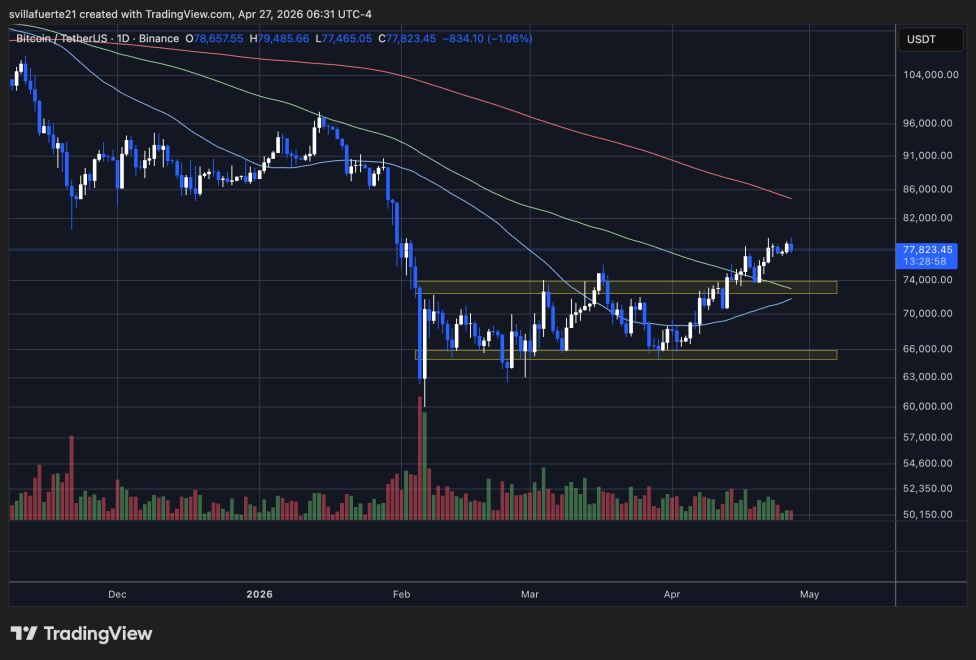
The trend remains technically fragile but improving. Price has reclaimed the 50-day moving average and is pressing into the 100-day, while the 200-day moving average still trends downward above price, acting as the primary macro resistance. Until BTC reclaims that longer-term average, the broader structure remains corrective rather than fully bullish.
Momentum is steady rather than explosive. The recovery from the $63,000–$66,000 base has been characterized by higher lows and controlled advances, not impulsive expansion. Volume supports this interpretation: the capitulation spike in February marked forced selling, while the subsequent rally has occurred on more moderate participation — consistent with accumulation rather than euphoria.
The key level now sits around $78,500–$80,000. This zone aligns with prior breakdown structure and likely contains trapped supply. A rejection here would suggest the market is still range-bound, with a potential retest of $73,000. A clean break above it, however, would shift the structure toward a trend continuation, opening the path toward the low $80,000s and beyond.
Featured image from ChatGPT, chart from TradingView.com